Welcome to the official website of Jim Brown - New Column appears each Monday!
This site is part of Brown Publications and The Lisburn Press
You are visiting my site on: August 31, 2026

College Friend Jim Reston Passes!

Jim Brown Audio Player
Getting your Trinity Audio player ready...

My good friend from college days at the University of North Carolina died recently. Jim Rushton wrote 18 books. He was a historian and novelist, and he provided a 96-page “interrogation” memo for David Frost’s TV interviews that prodded Nixon to admit, “I let the American people down” over Watergate.  He was a great athlete at Carolina, and still holds the record for scoring the most goals in a soccer match there.  We last visited in Linville, North Carolina on his book tour a year ago.  During our Carolina days, Jim and I would have dinner each evening at the Phi Delta Theta fraternity house. I wish our conversations had been recorded as we made a gallant effort to solve most of the world’s problems.  Jim was 82 years old and died of cancer.  I will sure miss my friend of 70 years.  To read his full biography, Click Here.



Monday, August 31st, 2026

Baton Rouge, Louisiana

GOING TO VOTE OR ELSE!

Why don’t more people show up to vote on Election Day?  In elections all over America, fewer voters are turning out at the polls than ever before. The New York Times ran an op-ed piece decrying this national trend, and suggesting that voting be mandatory, just like jury duty. So how big is the problem, and how important is it to force citizens to vote?

My home state of Louisiana recently held what traditionally is the largest election in any four-year period to pick congressional candidates and many local public offices.  Turnout was a miserable 17%.  Of course we should encourage all Americans to vote.  Participatory democracy is a hall mark of our system of government. 

In a recent op-ed article, William Galston with the Brookings Institution argues what he feels to be a number of advantages to mandatory voting.  He points out that thirty-one countries have some form of mandatory voting, including two thirds of Latin American nations and a cross section of other democracies that include Australia. 

All well and good, and few would argue with the advantages of lessening the tension of governing and creating an atmosphere for more political compromise, and less of the present “in your face” way of governing.  But what price is paid for such results?  Does the government have to hold a stick over your head with financial sanctions to force you to vote?  Australia, for example, fines any eligible voter who fails to show up at the polls.  A small fine to begin with, about the amount of a traffic ticket, with escalating amounts for repeated failures.  Yes, turnout is around 95 %, and Australians tend to see voting as a personal obligation, something not nearly as ingrained in the U.S.

Another reason voting percentages are way down is the fact that in many states, way too many elections are held. School boards and local taxing districts often pick an “off election” date, with few other items on the ballot.  They look to get their particular constituency to the polls with the hopes that those who oppose their proposition will not take the time to vote. In my home state of Louisiana, voters are often asked to vote four times or more per year, frequently with only one or two local issues on the ballot.

In many European countries, where voting participation is always quite high, one annual Election Day is held on a Sunday.  Families go to church and then take the time to vote, knowing that they will only have to vote once a year.  Generally, U.S. voters face too many elections of little interest to them, resulting in extremely low voter turnout.

Is democracy served by telling citizens that they have to show up and vote, regardless of their interest and/or ignorance of the candidates and the local issues? Can a registered voter be told by the government: “Regardless of your interest in this election, we are requiring you to show up, and if you don’t, you will be fined.”

And finally, how about the argument that not voting is actually a vote?  If all votes are your opinions, then by not voting, are you not expressing your opposition to all those candidates and items on the ballot? I remember back in the 1970’s as a Louisiana State Senator I introduced a proposed law to include “none of the above,” on the ballot.  Isn’t that what you’re indicating when you fail to vote?  And if so, isn’t this your constitutional right?

But making voting mandatory takes away the right of a citizen to choose. Freedom means the right to express your views as you see fit. Voting is one of those options.  So is non-voting.  It’s all about your freedom of choice, isn’t it?  To vote, or not to vote — that is your decision. But living with the consequences is not.

And voters can also take the advice of comedian W.C .Fields. “I never vote for anyone.  I always vote against.”   

Peace and Justice

Jim Brown

Jim Brown’s syndicated column appears each week in numerous newspapers throughout the nation and on websites worldwide. You can read all his past columns and see continuing updates at http://www.jimbrownla.com.


Leave a Reply

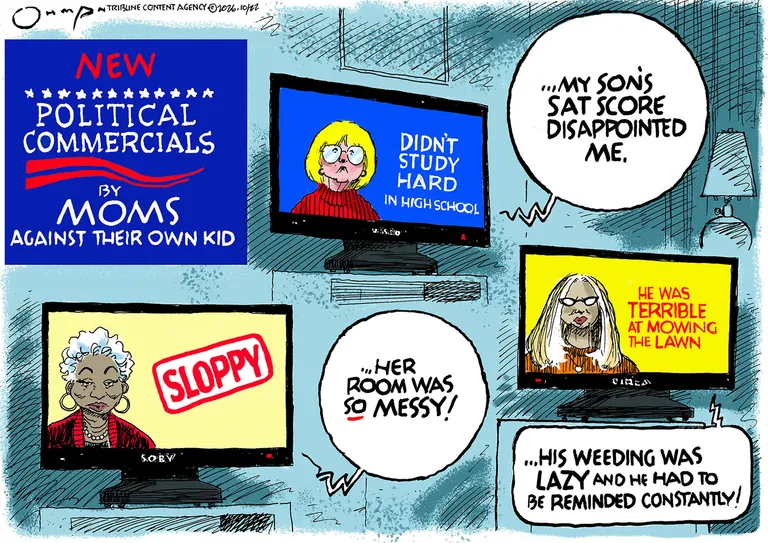
Weekly Cartoon

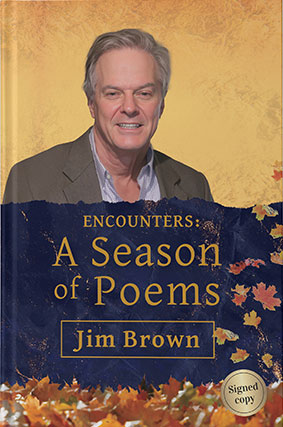
Order Encounters: A Season of Poems
by Clicking Here

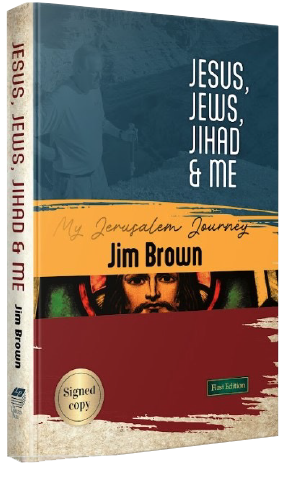
Order Jesus, Jews, Jihad and Me
by Clicking Here

DATELINE LOUISIANA PODCAST

To Listen, Click Here!

A provocative look at the deepest of the  deep southern states by two veterans of  Louisiana politics. Thoughts that are informative, candid, humorous, and  sometimes controversial about life in  one of the most interesting and rabble-rousing states in the nation.

To hear Jim Brown’s new regular podcast, Click Here.

JIM BROWN MERCHANDISE